

FastAPI vs Flask vs Django
Which One Should You Use for LLM Apps?

Let’s skip the theory.
If you’re building with LLMs — RAG systems, chatbots, assistants, or AI-powered APIs, the framework you choose matters more than you think.
Yes, they all “work.”
But the dev experience, performance, scalability, and integration pain differ wildly.
I’ve used all three across real-world AI projects.
Here’s what I’ve learned 👇
Frameworks compared at a glance.
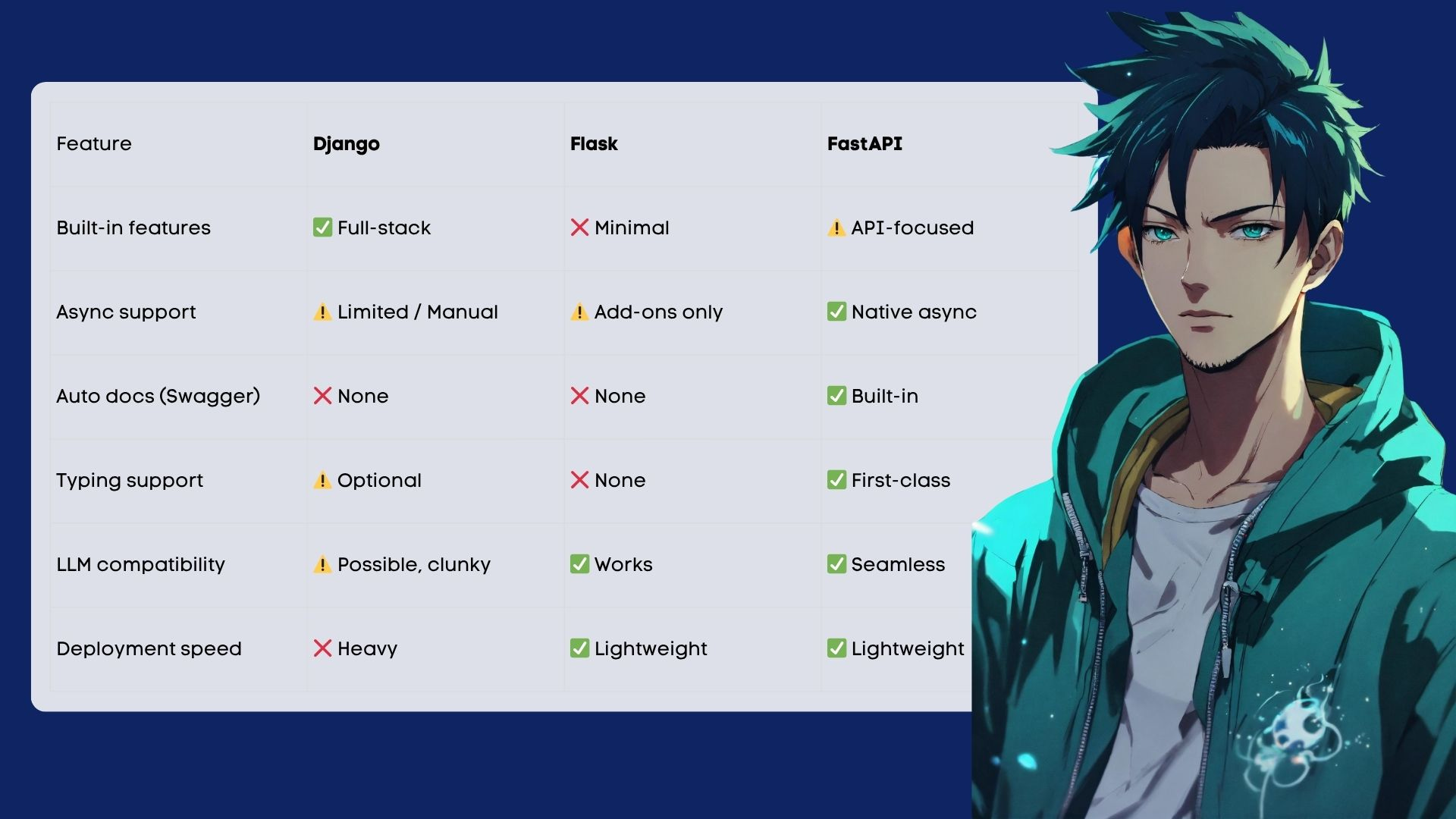
If you’re building an LLM API.
You want low latency, async, and type safety.
FastAPI wins here — every time.
Native support for
async def= non-blocking I/OPydantic validation means your input/output schema is tight
Swagger + OpenAPI docs out of the box
Plays well with LangChain, Transformers, OpenAI SDK
Best for:
→ Custom LLM endpoints
→ Chatbot APIs
→ Embedding + search pipelines
→ ML inference services
If you’re building an end-to-end app around LLMs
Let’s say you’re building:
A document Q&A tool
A multi-user AI dashboard
A tool where LLMs are just one feature
Django starts to shine here.
Why?
Comes with user auth, admin panel, ORM, views
Good for quickly wiring business logic, users, and UI
Add
DRF(Django Rest Framework) for APIsCan plug into Celery for background tasks (e.g., async LLM processing)
But be warned:
Django + LLMs = more setup, more complexity.
It works, but you’ll fight the framework sometimes.
Best for:
→ SaaS tools
→ AI platforms with login/payment/etc.
→ Use cases where LLM is a feature, not the product
If you want control (but lightweight)
Flask sits in the middle.
It’s:
Lightweight
Battle-tested
Minimal to the core
But it doesn’t scale elegantly unless you build the glue yourself.
Want async? You’ll need Quart or hacks.
Need auth? Add it.
Need docs? Write them.
Still, for simple LLM apps, it’s more than enough.
Best for:
→ Solo projects
→ One-off LLM demos
→ Lightweight tools or microservices
TL;DR — Which one to use?
Build + deploy fast LLM APIs → FastAPI
Build a complete product with LLM inside → Django
Quick demo or solo MVP → Flask
Some real-world examples.
1. FastAPI + OpenAI SDK
→ Custom chatbot API with streaming support
→ 20ms faster response time than Flask in production
→ Auto docs + Pydantic = saved time debugging prompts
2. Django + LangChain + Postgres
→ AI dashboard with user logins and document uploads
→ Used Django admin to review logs, users, and feedback
→ Celery queue for async LLM processing
3. Flask + Hugging Face Transformers
→ Deployed a small summarization service on EC2
→ Flask + Gunicorn = simple and stable
→ Perfect for a one-function tool
And here’s my take.
In 2026, AI engineers need frameworks that don’t slow them down.
For me, the stack looks like:
FastAPIfor buildingDjango,when I need structureuvfor envsDocker+Fly.ioorRenderfor deploymentObservability from Day 1
Your framework should fit your product, not your nostalgia.
Want more breakdowns like this?
Every week, I send out practical posts like this:
→ Building LLM systems
→ Tools that actually work
→ Dev workflows that scale
→ No hype. Just how it works.
Let’s stop building demos.
Let’s build systems that last.
Hey, great read as always. Your LLM insights are gold! But Flask offers a nice midle ground to.